How to trade on Binance

The largest crypto exchange in the world: the deepest books, the biggest P2P and a whole ecosystem in one place. Where to start and where the savings are.

Open the exchange ↗

What Binance is and why people start here

Binance launched in 2017 and became the largest crypto exchange in the world in under a year. It still holds that place, and not because of marketing: there is simply more money here. The book on bitcoin and ether is deeper than anywhere else, which means you buy or sell size at the price you see rather than the price you get after slippage.

For a newcomer that is the main argument. You will almost never face a situation where there is nothing to trade a coin against or your order sits unfilled. For an experienced trader it holds too: the Binance price is effectively treated as the market price, and gaps on other venues are measured from it.
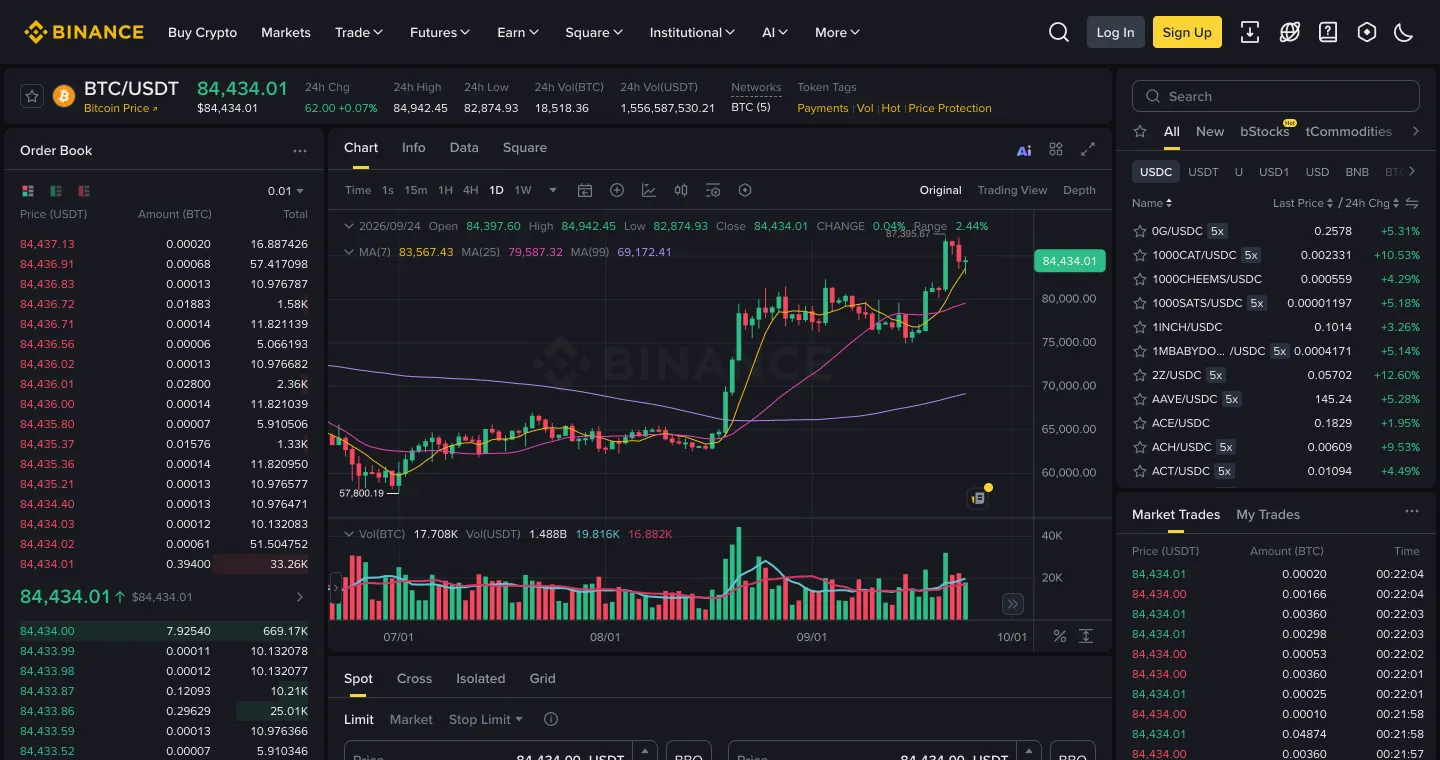
The Binance trading terminal: chart, order book and trade tape for BTC/USDT

What else is here besides plain trading

Binance has long been more than an exchange. Here is what people actually use.

Spot trading — buying coin for coin or for USDT. Nearly five hundred pairs against USDT alone, from bitcoin to tokens you have never heard of.

Perpetual futures — over eight hundred leveraged contracts. Funding is settled here: hold a position and every eight hours you either pay or get paid. A whole kind of arbitrage is built on that, and we have a section for it.

Options — rare among exchanges. They cap your loss in advance: you pay a premium and gain a right rather than an obligation.

P2P — buying crypto for ordinary money directly from people. Hryvnia, zloty, lira, tenge and fifty more currencies, dozens of payment methods. For many this is the only way in, and these are the rates we show in our P2P section.

Earn — savings and staking. A coin sits and earns interest: flexible, withdrawable any time, or locked for a term at a higher rate.

Launchpad and Launchpool — taking part in new coin releases before they reach open trading.

Copy trading and bots — mirroring other traders and automated strategies such as grid trading, configured right in the interface.

The Binance card — paying from a crypto balance wherever ordinary cards are accepted.

Fees: what you actually pay

The base spot rate is a tenth of a percent on both sides of a trade. There are two ways to cut it, and they stack.

First, hold BNB, the exchange token, and switch fee payment to it for a discount. Second, trade more: Binance has tiers, and the rate falls automatically as monthly volume grows.

Futures rates run below spot, and the maker — whoever posts a limit order and waits — pays less than the taker who lifts someone else at market. Getting into the habit of posting limit orders saves real money over time.

Getting money in and out

The most common route in our region is P2P. You pick an ad, send money to the seller by card, and they release the crypto from escrow. The exchange acts as guarantor: while the deal runs, the coins are frozen and the seller cannot take them back.
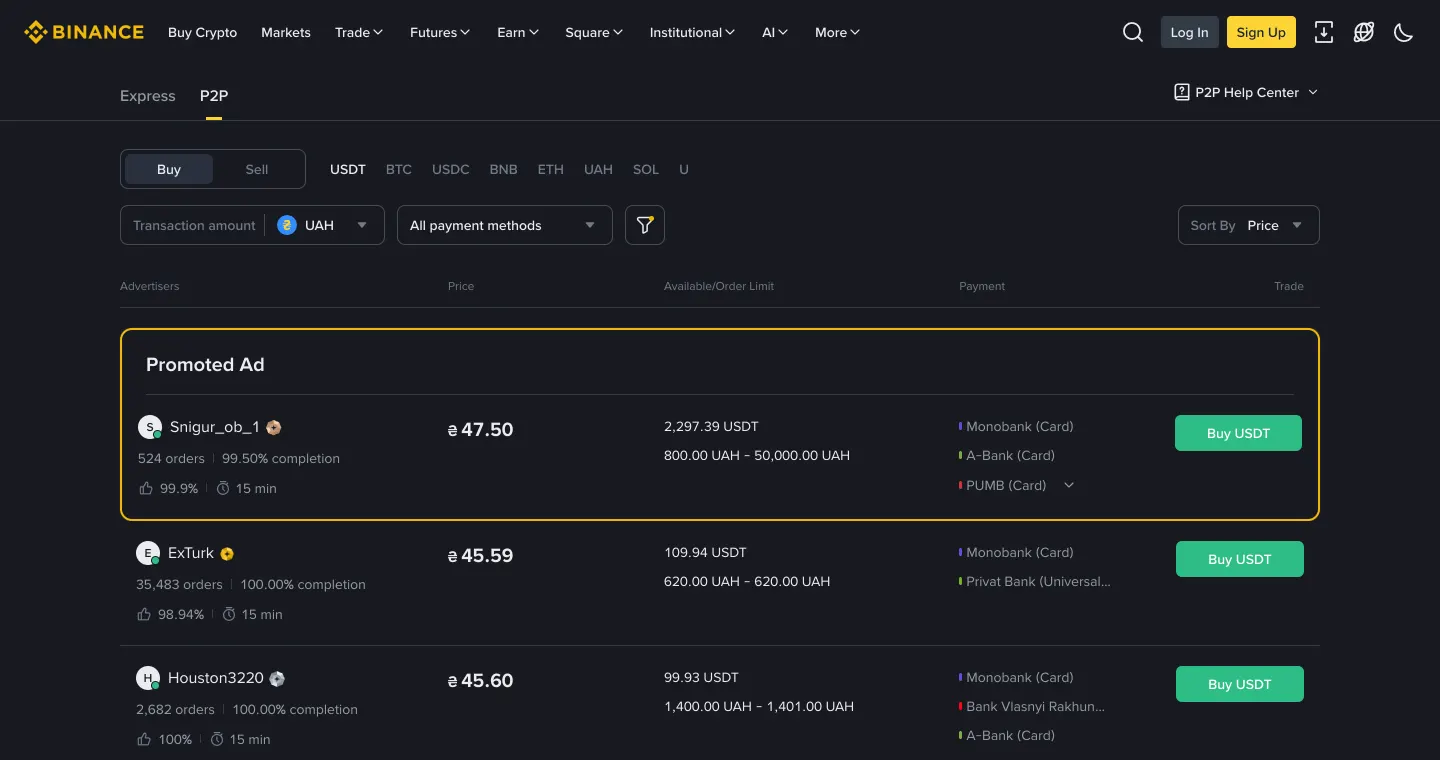
The P2P section on Binance: ads with price, limits and payment methods

Coins leave through networks. This is where people lose the most through inattention: the cost of a transfer depends on the network, not the amount. The same USDT costs 0.01 to withdraw on BSC and noticeably more on Ethereum. Nineteen networks to choose from, with a hundredfold spread between them.

Current figures for every coin and network are collected straight from the exchange and sit in the live table at the top of this page.

What to know in advance

New coins reach Binance later than early-listing venues such as MEXC or Gate: the exchange screens projects more strictly. If you hunt new listings specifically, keep a second venue for that.

And note that Binance does not operate identically everywhere — which services you get depends on your jurisdiction. Check what is available to you before funding an account.

Who it suits

Almost anyone starting out. A deep book forgives a beginner's mistakes, the breadth of services means no second account just for staking or futures, and cheap BSC withdrawals make it a comfortable anchor for cross-exchange routes.

If you already trade and hunt rare coins, keep Binance as your main venue with an early-listing exchange alongside. Those two cover nearly everything.

Frequently asked

Do I need verification to trade?
Basic verification for spot trading. Full verification, with a document and a selfie, for P2P, fiat funding and any meaningful withdrawal.
How do I reduce fees?
Turn on paying fees in BNB — it discounts every trade and is a single toggle. Beyond that the discount grows with monthly volume.
Which network is cheapest to withdraw on?
It depends on the coin and current network load. The table at the top of this page shows live fees per network — usually TRON and BSC are cheapest, Ethereum dearest.
Why is a withdrawal sometimes delayed?
Large or unusual transfers go to manual review. Answering the source-of-funds question is usually enough; completing verification in advance reduces the chance of a hold.

Exchange comparisons

Binance or BybitThe biggest exchange in the world against the best derivatives terminal. A feature-by-feature look at what each one gives you.Binance or OKXTwo venues with genuinely deep books. A look at what each one does and why people keep both.Binance or MEXCDepth and ecosystem against early listings and a zero maker fee. A look at when each one pays off.Binance or KuCoinThe default venue against the exchange with the best trading bots. A look at what keeps people on the second one.Binance or BitgetThe largest exchange against the largest copy-trading venue. A feature-by-feature look at who needs the second one.Binance or KrakenThe largest crypto exchange against the oldest regulated one. These are two different ways to hold money — here is both.Binance or WhiteBITThe largest venue against a European one with Ukrainian roots. The choice here is not about size.Binance vs GateGate catches new listings first; Binance lets you fill a large order without slippage. That is the whole fork.Binance vs HTXBinance and HTX both cover almost any job, so the choice is not the feature list but what you actually use daily.Binance vs BingXBinance does everything and does it on the deepest market; BingX focuses on leveraged trading. Scale against focus.Binance vs WEEXAn all-rounder against a terminal: Binance has the deeper book and wider service set, WEEX the smoother contract trading.Binance vs ToobitAn all-rounder against a terminal: Binance has the deeper book and wider service set, Toobit the smoother contract trading.Binance vs LBankWhere the book is deeper, new coins arrive later: Binance wins on volume, LBank on getting fresh tickers first.Binance vs PhemexAn all-rounder against a terminal: Binance has the deeper book and wider service set, Phemex the smoother contract trading.Binance vs XT.comBinance and XT.com both cover almost any job, so the choice is not the feature list but what you actually use daily.Binance vs KCEXTwo full ecosystems. Binance is stronger at the core — book and P2P; KCEX is more interesting around the trading itself.Binance vs OurbitTwo full ecosystems. Binance is stronger at the core — book and P2P; Ourbit is more interesting around the trading itself.Binance vs BigONEBinance and BigONE both cover almost any job, so the choice is not the feature list but what you actually use daily.Binance vs Crypto.comBinance and Crypto.com both cover almost any job, so the choice is not the feature list but what you actually use daily.Binance vs HotcoinBinance and Hotcoin both cover almost any job, so the choice is not the feature list but what you actually use daily.Binance vs PionexTwo full ecosystems. Binance is stronger at the core — book and P2P; Pionex is more interesting around the trading itself.Binance vs HIBTTwo full ecosystems. Binance is stronger at the core — book and P2P; HIBT is more interesting around the trading itself.Binance vs ZoomexBinance and Zoomex both cover almost any job, so the choice is not the feature list but what you actually use daily.Binance vs xRocketBinance and xRocket both cover almost any job, so the choice is not the feature list but what you actually use daily.

Other exchanges

How to trade on Bybit

An exchange built on derivatives and licensed in Dubai: one of the best futures terminals, a unified account, and a record twenty withdrawal networks.

How to trade on OKX

One of only two venues with genuinely deep books. A complete derivatives set, a built-in Web3 wallet and its own network with free withdrawals.

How to trade on MEXC

The venue where new coins appear first and the spot maker fee is zero. Here is who benefits from that.

How to trade on KuCoin

The exchange with the best built-in trading bots: grid, DCA and arbitrage, configured with a mouse and no code at all.