Why a listing moves the price
When a major exchange announces it is adding a coin, something simple happens: the asset suddenly gains access to a huge audience that previously had nowhere to buy it. Demand arrives faster than supply and the price reacts.
For arbitrage something else matters more. At listing, the coin appears on a venue where nobody has priced it yet — and for a while its price lives separately from the rest of the market. That is the window.
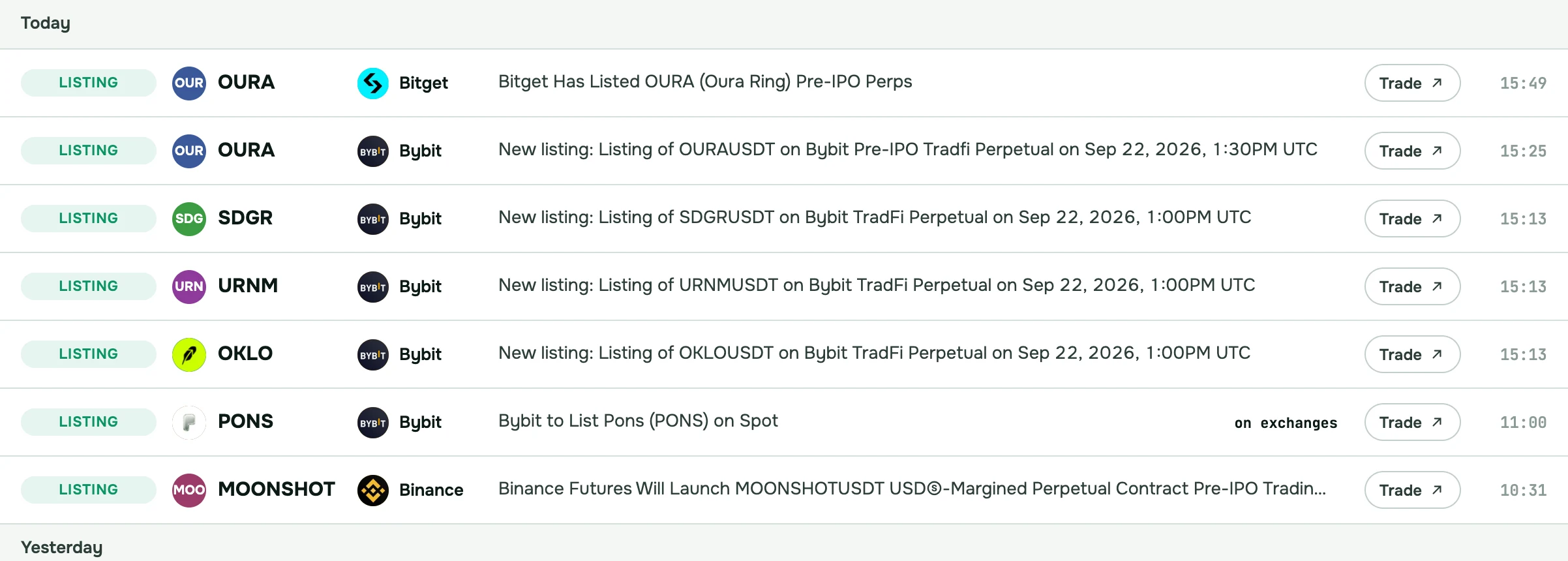
What the section shows
The listing calendar collects exchange announcements: which coin, which venue, when trading starts.
Entries that came from our own observation rather than a press release are marked separately: some exchanges do not publish announcements programmatically, but a new pair appears in their instrument reference, which we record while stating the source honestly.
How to use it
- Look at the trading start time, not just the announcement date. The movement is in the first minutes.
- Check where the coin trades now. If it already exists elsewhere, compare prices — a gap appears right after the start.
- Check transfers. On listing day exchanges often open deposits before trading. That is the only way to have the coin in place for the start.
- Do not count on fast withdrawals. In the first hours they are often restricted.
Two different scenarios
The coin already trades elsewhere. Then this is ordinary cross-exchange arbitrage: buy where it exists, fund the new venue in advance, sell after the start. Moderate risk, short window.
The coin is new everywhere. Then there is no arbitrage at all — there is a bet on price, because there is nothing to compare against. Treat it accordingly.
What to expect in the first minutes
- The book is nearly empty. Slippage is enormous and limit orders behave oddly.
- The price swings by tens of percent in both directions.
- Cross-venue spreads look fantastic and are almost never executable at the stated size.
- Withdrawals are often closed, leaving no way to close the route.
The practical conclusion: the first minutes of a listing are the noisiest time on the market. Sensible work usually starts later, once the book fills.
Frequently asked
Does a coin always rise after listing? No. Often it jumps on the announcement and falls after trading opens, when those who bought early start selling.
Why do some entries show a source? Because some exchanges do not serve announcements programmatically, so the entry records when the pair appeared in their reference. We prefer to mark that rather than present it as official.
Where do I see the price right after the start? In cross-exchange arbitrage, and check depth in order books.