What this section is about
There is a job crypto does better than a bank: moving money across borders. A bank transfer takes days, costs a fixed amount and invites questions. USDT takes minutes.
But whether it pays for you specifically depends on comparing the whole path rather than individual steps. The SWIFT section works out the crypto path on live data: buying USDT for one currency and selling it for another at the P2P venues' median prices, converting back at the official cross rate and taking off the bank fee, a percentage plus a fixed part.
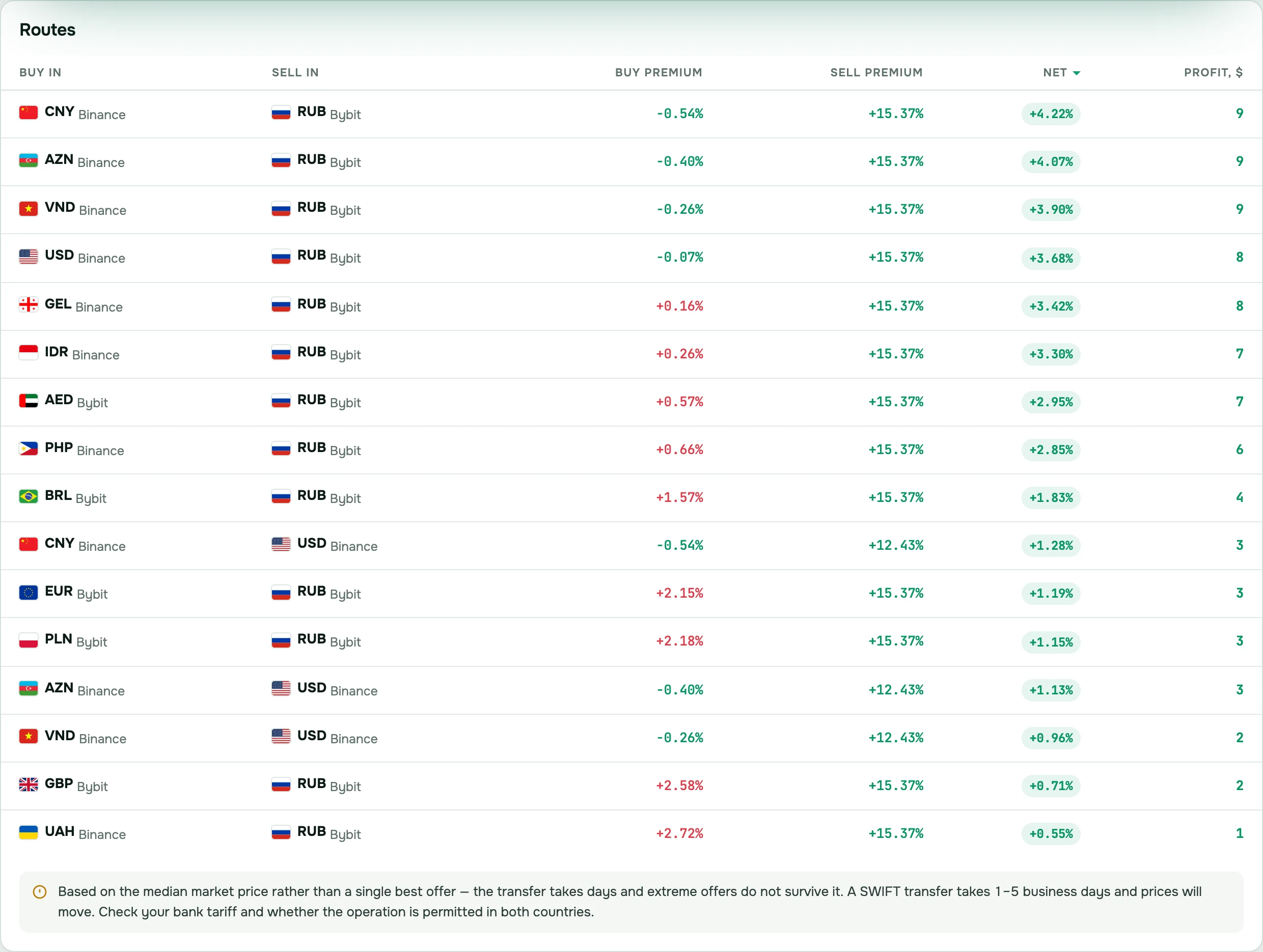
The two routes being compared
The bank path. You hand over money in your currency, the bank converts at its own rate, charges for the transfer, the correspondent bank takes its cut and so does the receiving bank. It arrives in one to five working days.
The crypto path. Buy USDT on P2P in your currency, move it on the blockchain, sell it on P2P for the target currency. It arrives in minutes or tens of minutes.
Both lose you money on four things: the conversion rate in, the transfer fee, the conversion rate out, and time.
Where crypto wins
- The transfer fee barely depends on the amount. Banks charge a percentage or a fixed sum with thresholds; a blockchain charges pennies regardless of size.
- Speed. Minutes against days.
- The rate. Bank rates are usually 1–3% worse than market; P2P sits closer to market.
- Weekends. Banks are closed, P2P is not.
Where the bank wins
- Transparency for the state. A bank transfer is a legal document; crypto needs separate handling with the tax authority.
- No human factor. On P2P you deal with people.
- Large amounts. On P2P a big sum has to be split across several trades.
- No network mistakes. Bank details are harder to get wrong than a transfer network.
Counting honestly
Compare the amount that arrives, not the percentages per step. The crypto route works out as: losing on the gap when buying, paying the network fee, losing on the gap again when selling.
A practical benchmark: the whole path usually costs 1.5–3%. Bank transfers often cost more on small amounts because of fixed fees, and become comparable on large ones.
What to check before transferring
- Whether a P2P market exists in the destination currency. With a dozen offers there will be nowhere to sell.
- That the network matches on sending and receiving.
- Offer limits — a large sum will need splitting.
- How your bank views such operations.
Frequently asked
Is it legal? Buying and selling crypto is legal in most countries. Currency control and tax questions depend on your jurisdiction.
From what amount does crypto win? Usually on smaller ones, where fixed bank fees take the largest share. On very large sums the difference narrows.
What is the slowest part? The blockchain transfer takes minutes. Finding offers with suitable limits on both sides takes longer.