What it is and where the catch sits
The same coin costs different amounts on different exchanges because each venue has its own book. The scheme looks simple: buy where it is cheaper, transfer, sell where it is dearer.
All the difficulty is in the word transfer. While the coin travels through the blockchain the price moves, and a 1.5% route can become zero. This is why experienced arbitrageurs do not move coins at the moment of the trade. They keep money on both exchanges in advance and close both sides simultaneously, using transfers only to rebalance afterwards, at leisure.
If you take only one thing from this article, take that.
Two schemes: the slow one and the right one
The slow one. See a spread → buy on exchange A → withdraw → wait 5–20 minutes → sell on exchange B. By the time you sell, the spread has often gone.
The right one. USDT sits on exchange A, the coin sits on exchange B. See a spread → buy the coin on A and simultaneously sell it on B → both trades close in seconds and the spread is locked. Later, at your convenience, you transfer to restore the original positions.
The price of this is that your capital is split and part of it always sits idle.
Step 1. Set up the scanner
Open cross-exchange arbitrage.

Capital — your real amount.
Trading fee — your actual one. It is subtracted twice, on the buy and on the sell. If you have a discount for holding an exchange token, enter it.
Minimum 24-hour volume — the main quality filter. A coin turning over a couple of thousand dollars will show any spread you like, and you will not be able to sell there.
Spread bounds — the lower one cuts noise, the upper one removes obviously unreal rows.
Step 2. Read the table
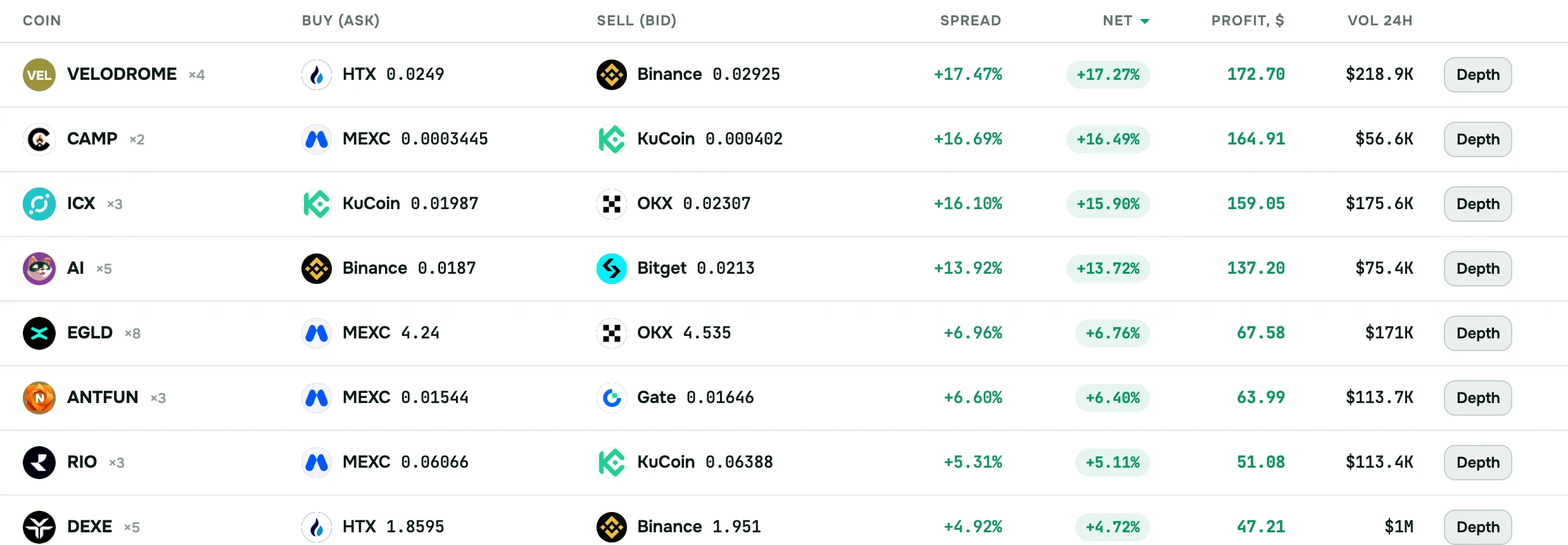
Before opening an exchange, check the book depth. The price in the table is the best offer. If only 200 dollars sits behind it and you arrive with a thousand, the rest fills worse. That is what order books are for.
Step 3. Check the coin can actually be moved
The step people skip and then write to support about. A beautiful spread very often means exactly one thing: withdrawals of that coin are suspended on one of the exchanges. The price diverged precisely because arbitrageurs cannot close it.
- Open transfers and find the coin.
- Check withdrawals are open on the buying exchange and deposits on the selling one.
- Make sure both share a common network.
- Look at the transfer fee — on cheap coins it can eat the whole profit.
Step 4. Making the trades
- Buy. On a thin market use a limit order — a market order will eat the difference.
- Sell. Working the right way, you sell the same coin simultaneously on the second exchange from your existing reserve.
- Check. Make sure both orders filled completely. A partially filled order is an open position, not arbitrage.
Step 5. Rebalancing
- On the exchange with the surplus, open Withdraw.
- Pick the cheapest of the shared networks.
- Copy the deposit address with the button, not by hand.
- Check for a MEMO or tag if the exchange showed one.
Transfer when the imbalance has built up rather than after every trade: the fee does not depend on the amount, so one large transfer beats five small ones.
What it pays
On 1000 dollars at a 1.2% spread the gap is 12 dollars. A 0.1% buying fee is 1 dollar, the same on the sell. A transfer on a cheap network is 0.2. Slippage on a normal pair is around 1.5. That leaves about 8.3 dollars, or 0.83% net.
Hence the benchmark: on cross-exchange spot, a route under 0.6% usually does not pay. That is less than P2P, and there is nothing strange about it — the easier a gap is to close, the smaller it is.
Common mistakes
- Not checking withdrawals. The most common cause of stuck routes.
- Transferring during the trade. The spread closes while you wait. Keep balances in advance.
- Ignoring book depth. The best price is often good for two hundred dollars.
- Using market orders on thin pairs. Slippage takes the whole spread.
- Chasing exotics. A 30% spread on a coin turning over 5000 dollars is not an opportunity.
Frequently asked
How much capital? More than for P2P, since money is split across two exchanges. Sensibly, from a thousand dollars.
Why are spreads smaller than on P2P? Because the gap is easy to close here, and bots do it in seconds. Wide spreads live where there is a barrier.
Which coins work best? Liquid ones with cheap, fast transfers. Exotics show big percentages and do not deliver them.
What if a coin gets stuck? It usually arrives — blockchains do not lose transfers. Check the transaction hash in a network explorer, then contact support.