What a DEX to CEX route is and why it lives longer
A decentralised exchange is a smart contract on a blockchain. No company, no registration: you connect a wallet and swap coins straight out of it. The price there comes from the ratio of two coins in a pool, and a new token appears on launch day rather than after a listing.
A centralised exchange is a company with a database. Trades are instant and the book is dense, but a coin only arrives after listing.
That is where the earnings come from. Between two centralised exchanges a gap closes in seconds. Between a pool and an exchange it cannot: closing it means physically moving coins through the blockchain, paying gas and waiting for confirmations. So a gap of several percent on a fresh token can last for hours.
What to prepare first
- A wallet. MetaMask for Ethereum, BNB Chain, Base, Arbitrum, Polygon, Optimism and Avalanche. Phantom for Solana.
- Your recovery phrase written on paper. Not in phone notes, not a screenshot. Lose it and everything is gone — there is no support desk in a blockchain.
- Native coin for gas. BNB for BNB Chain, ETH for Ethereum and Base, SOL for Solana. Without it you cannot make a single move.
- An account on the exchange you will sell into, verified.
Step 1. Find the route on the scanner
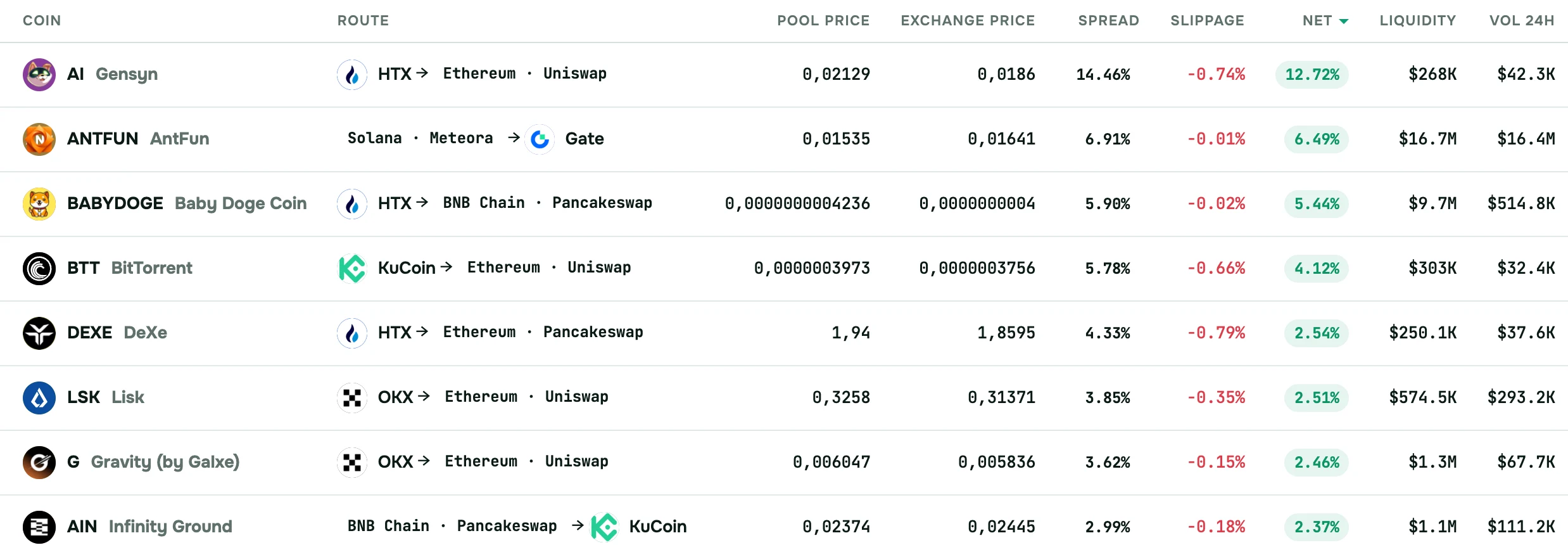
Open the DEX scanner. It takes the token price in a pool and compares it with the same coin on centralised exchanges, across eight networks at once.

Capital is the most important field. The larger your amount, the more it moves the price inside the pool. Enter your real figure and half the pretty routes vanish by themselves. That is not a bug, that is the truth.
Pool fee — typical values: 0.3% on classic pools, 0.05% on stablecoin pools, up to 1% on small pairs.
Minimum liquidity cuts out pools with no money in them. In a 30 000 $ pool a 3 000 $ trade eats around 9% of the gap before any fees.
Networks — keep Ethereum off if you work with small amounts: one transaction there costs more than the entire profit on three hundred dollars.
Step 2. Check the token before it is too late
This is the step that separates earning from losing everything. Anyone can create a token with any name on a blockchain.
- Take the contract address from the route, not the coin name.
- Open the withdrawal page for that coin on your exchange and compare the contract address. Different contract means different token, and there is no route.
- Look at pool age and trading volume. A pool created an hour ago with 40 000 $ of liquidity is bait, not an opportunity.
One trap worth knowing by name: some tokens can be bought but not sold — the contract blocks selling for everyone except the creator. The defence is simple: only work with tokens that at least one centralised exchange accepts.
Step 3. Buy in the pool
- Open the decentralised exchange for that network: Uniswap, PancakeSwap, Raydium or Jupiter.
- Press Connect Wallet. Connecting gives no access to your money — it only reads your address.
- Paste the contract address into the token field. Do not search by name: there are hundreds of identical names, the address is unique.
- Check slippage in the settings. 0.5–1% for liquid pairs, up to 3% for small ones. Set 20% and 20% is what you will lose.
- For a token you are spending for the first time the wallet asks for Approve — a separate transaction with its own gas.
- Press Swap and read carefully what the wallet shows.
Step 4. Move it to the exchange
- On the exchange open Deposit → pick the coin you bought.
- Choose the network — exactly the one you bought the token on.
- Copy the address with the copy button.
- In the wallet press Send, paste the address, enter the amount.
- Leave some native coin for gas, or the transaction will not go.
Which network is cheapest on which exchange is in transfers.
Step 5. Sell on the exchange
- Wait for the deposit to credit.
- Open the USDT pair and look at the book, not just the last price.
- If the amount is meaningful, sell with limit orders in parts. A market order on a thin pair will eat the very gap you came for.
How the real profit works out
Five things come out of the spread, and the last two are usually forgotten: the pool fee, slippage, gas for approve, gas for the swap and the transfer, and the exchange selling fee.
An example on 1000 dollars in BNB Chain: pool fee 0.3% is 3 dollars, slippage around 0.4% is 4 dollars, gas for two transactions about 0.6, exchange fee 0.1% is 1 dollar. Around 8.6 dollars of costs, so a route under 1% at this size is pointless.
The same trade on a busy Ethereum: gas alone can take 15–40 dollars, pushing the break-even to 4–5%.
Common mistakes
- Searching by token name instead of contract address. The fastest way to buy a fake.
- Leaving no gas. You swapped everything and now cannot send the coins anywhere.
- Setting high slippage. The difference goes to whoever front-runs you.
- Forgetting Ethereum gas in the maths. A 2% route with 30 dollars of gas on a thousand is a loss.
- Buying a token no exchange lists. There will be nowhere to sell it.
Frequently asked
Do I need a wallet if I only trade on exchanges? No. Start with P2P arbitrage, the entry bar is lower.
From what amount does this make sense? In cheap networks from 300–500 dollars. On Ethereum, from several thousand.
Which is safer, CEX or DEX? They are different risks, not different levels. On an exchange you trust a company; in a wallet you answer for everything and mistakes are irreversible.
Can I go the other way, from exchange to pool? Yes, the scanner shows both directions. Steps 3 and 5 simply swap places.