Income that does not care where the market goes
This is probably the calmest scheme of them all. You hold a coin and simultaneously short the same coin in futures. Price goes up — spot gains, futures loses. Price falls — the other way round. Net zero, and what happens on the chart becomes literally irrelevant to you.
The money comes from a third place: the funding rate that the two sides of a perpetual futures contract pay each other every few hours.
Where the funding rate comes from
A perpetual contract has no delivery date, so something has to hold it near the real price. Funding is that mechanism.
When the contract trades above spot, longs pay shorts. When it trades below, the reverse. The payment settles automatically on a schedule, usually every eight hours, though some exchanges do it more often.
What the full position looks like
- Buy the coin on spot for amount X.
- Open a short on the perpetual for the same amount X.
- Hold both and collect funding while the rate is positive.
- Close both sides when the rate turns negative.
This is called delta-neutral: total exposure to price is zero.
Step 1. Find the rate on the scanner
Open funding.

The annualised figure is there for comparison: 0.05% per eight hours looks modest, but it is around 55% a year.
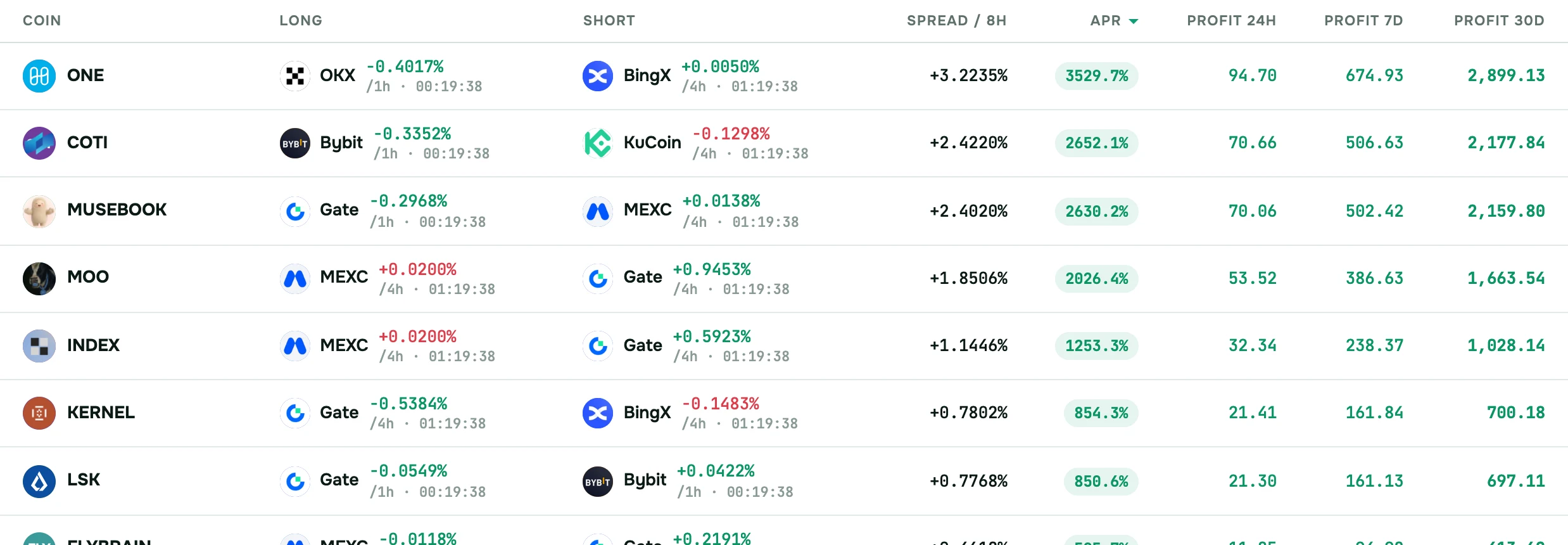
An important detail: we annualise from the real settlement interval, not from an assumption that it is eight hours. Some venues settle every four hours or every hour.
Step 2. Catch the settlement moment
The rate matters exactly when it pays. Hold for seven hours and close a minute before settlement and you get nothing. Enter a minute before and you collect the full payment.
So the time of the next settlement matters more than the rate itself.  Toobit and
 Phemex both show their funding interval per contract in our table. The next settlement time is there for Toobit, as for Binance, Bybit, OKX and most other exchanges, but not for Phemex: our data has none for it, so check it on the exchange itself.
Step 3. Work out what is left
An example. A 0.05% rate per eight hours on 1000 dollars is 0.5 dollars per settlement, 1.5 a day. Four trades at 0.05% to open and close both sides cost 2 dollars. So one payment does not cover the costs: the position needs to be held for at least a couple of days, after which it nets about a dollar a day.
Hence the rule: funding is about holding, not about a single entry. Frequent re-entries eat the income in fees.
The main risk: liquidation of the short
Spot cannot be liquidated; futures can. If the coin rises sharply the short goes into loss, and without enough margin the exchange closes it. After that you are left holding only spot — an ordinary purchase at a bad price.
- Do not use leverage. A 1:1 ratio between spot and futures is the correct size.
- Keep spare margin on the futures account to survive a rise of tens of percent.
- Watch the liquidation price — the exchange shows it in the position.
- On a unified account, remember collateral is shared: a futures loss reaches the whole balance.
Common mistakes
- Opening only the futures leg. Without spot it is not arbitrage, it is a bet against the market.
- Adding leverage for efficiency. That turns liquidation from unlikely into routine.
- Chasing extreme rates. A 1% rate per eight hours appears on coins that double in a day.
- Ignoring the settlement interval. 0.05% hourly and 0.05% every eight hours differ eightfold.
Frequently asked
Is it really risk-free? No. Price risk is removed, but liquidation risk, exchange risk and the risk of the rate flipping remain.
What does it pay annually? On calm coins 10–30%, on hot ones considerably more along with the risk.
Can spot and futures sit on different exchanges? Yes, and sometimes it pays better, but then margin must be managed by hand on both.
Which exchange is most convenient? Ones where both the interval and the settlement time are visible. Our table shows the interval for Toobit and Phemex alike, and the next settlement time for Toobit but not for Phemex.