The idea in two sentences
A stablecoin is supposed to be worth one dollar. Sometimes it is worth 0.994 or 1.003 — and if you buy during the deviation and wait for the return to a dollar, the difference is yours.
The deviations are tiny, but the scheme is clear: you are not guessing where the market goes, you are betting that the stablecoin returns to where it left. Usually it does.
The key question: measured against what
People skip this one, and it decides everything.
Almost everything on exchanges is quoted in USDT, so the easy move is to treat USDT as a dollar. But USDT is not a dollar: it regularly trades at 0.9996–0.9998. Measure from it and every second coin shows a deviation of exactly that size which does not really exist.
A real dollar has to come from where one exists.  Kraken trades pairs against live USD with bank funding — around seven hundred of them. The USDT/USD pairs of every venue with a live dollar, such as Kraken, price USDT itself: the middle of the book on each, the median across them. Everything else converts through it.
That is how our stablecoin section works, and the reference rate is shown on the board. Without that correction the numbers would be invented.
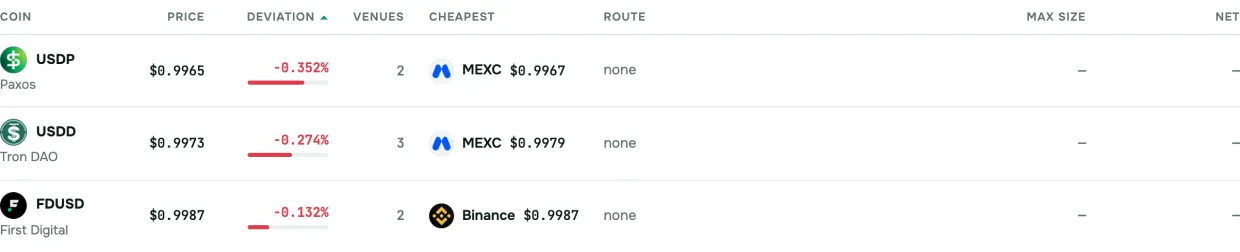
Why a stablecoin deviates at all
- Demand imbalance. Many people moving into or out of the stablecoin at once, faster than the book absorbs.
- News about the issuer. Doubts about reserves move the price immediately.
- A thin market on one pair. On a small venue the deviation may just be an empty book.
- Cross-network gaps. The same stablecoin sometimes prices differently in different networks.
The first two return to the dollar. The third does not: nothing deviated there, there is simply nobody trading.
What the trade looks like
- Find a stablecoin trading meaningfully below a dollar.
- Confirm the deviation is on a liquid pair, not a dead one.
- Buy.
- Wait for the return to a dollar and sell.
The second variant skips the waiting: if the same stablecoin prices differently on two venues, buy on the cheaper and sell immediately on the dearer. That is ordinary cross-exchange arbitrage applied to a stablecoin.
What it pays and when to skip it
A typical deviation is 0.1–0.4%, so 1–4 dollars on a thousand. Two trades at 0.1% cost 2 dollars.
The conclusion is direct: a deviation under 0.3% does not pay at ordinary fees. The scheme makes sense on larger amounts or where the maker fee is zero.
The main risk: it may not come back
You are betting on a return to the dollar. Usually it happens. But if the deviation reflects genuine trouble at the issuer, the coin does not return and you are left holding a falling asset.
- Work with large stablecoins that have a known issuer and public reporting.
- A deviation above 2% is a signal, not an opportunity. Markets are rarely that wrong; more likely they know something.
- Do not hold indefinitely: if the return has not happened in a reasonable time, exit.
Common mistakes
- Measuring from USDT as if it were a dollar. Half your deviations will be its own.
- Taking a deviation on a dead pair. One order drew that price.
- Confusing networks. One stablecoin across networks means separate markets and separate prices.
- Treating the scheme as risk-free. It is stable, not guaranteed.
Frequently asked
Why does your dollar rate differ from my bank? We use the exchange rate of a live USD pair rather than a central bank rate. For deviation maths the market rate is what matters.
What deviation is worth trading? From 0.3% at ordinary fees. Anything above 2% needs the cause understood first.
Can I lose on this? Yes, if the deviation reflects real issuer problems and there is no return.